
Modern logistics: freight containers
In this new series, we explain important terms, systems and technologies from the world of logistics. Today: the freight container.
reading time: 8 minutes
What are containers?
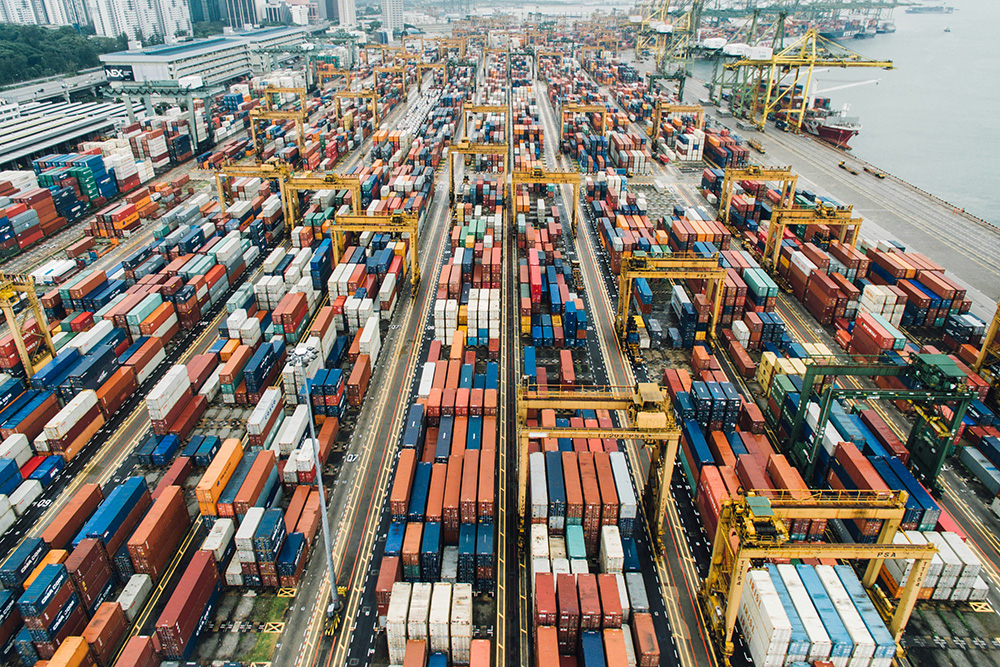
Containers are standardised, reusable transport containers used to move goods safely, efficiently and cost-effectively via various modes of transport such as ships, trains and lorries. There are different types of containers, which vary in size and design, but the most commonly used type is the ISO container, which is standardised for uniform use worldwide.
What are the advantages of containers?
Containers offer an efficient way to transport goods because they can be easily transferred from one mode of transport to another without having to unload and reload the goods themselves. This reduces costs, the risk of damage and the time required for transport.
How are containers used in logistics?
Containers play a central role in the logistics sector. They are used in almost all areas of freight transport, especially in international trade. Some of the most important areas of application are:
- Sea freight: The majority of global goods traffic is carried out by ships that transport containers. Containers can be stacked in large quantities on cargo ships, ensuring that space is used optimally.
- Rail transport: After sea transport, containers are often loaded onto trains to transport them to inland regions. Rail transport enables containers to be transported over long distances with high efficiency.
- Road transport: Containers are loaded onto special trucks that transport them to their final destination. Road transport is particularly suitable for shorter distances and for distribution within a country or region.
- Air freight: Although containers are less common in air transport, there are special air freight containers that are used for transport by plane. These are usually smaller and lighter than containers used in sea or land transport.
Since when have containers been in use?
The history of containers began in the 1950s, when American entrepreneur Malcom McLean had the idea of developing standardised containers that could be used on ships, trains and lorries. In 1956, the first container ship, the Ideal X, was loaded and left the port of Newark in New Jersey. This marked the beginning of a revolution in global trade. Before the introduction of containers, the transport of goods was very labour-intensive and inefficient. Goods often had to be loaded individually, which required a lot of time and manpower. The introduction of containers greatly simplified the entire transport process. Containers enabled a drastic reduction in handling times at ports and terminals and led to significant cost savings. In the following decades, container transport spread worldwide. The International Organisation for Standardisation (ISO) introduced standards for container sizes and specifications, which further facilitated global trade. The two most common container sizes today are the 20-foot container (TEU) and the 40-foot container (FEU).
How will the container sector develop in the future?
Various developments are expected in the future that could further change the use of containers in the logistics industry:
- Automation: Container ports and warehouses are becoming increasingly automated. Robots, autonomous vehicles, and crane systems could make the transport and storage of containers even more efficient. This could also further reduce turnaround times and lower costs.
- Sustainability: More environmentally friendly materials and technologies will gain importance in container production and transport. Containers could be made from lighter and recyclable materials in the future to reduce their carbon footprint. Furthermore, more environmentally friendly propulsion systems for cargo ships and trucks could make container transport more sustainable.
- Digitalization: Digitalization will play a key role in monitoring container movements and optimizing the logistics chain. Networked containers with sensors could monitor location, temperature, humidity, and other parameters in real time. This will be particularly important for temperature-sensitive goods such as food or pharmaceuticals.
- Hyperloop and new transport systems: Concepts like the Hyperloop could play a role in freight transport in the future. This could make container transport even faster and more efficient, especially by road.
- Flexible-sized containers: Innovative designs could allow containers to be more flexibly adjusted in size to optimally adapt to the goods being transported and to use space even more efficiently.
Overall, the container remains a central element of the global logistics chain, constantly evolving to meet the growing demands of world trade.
Do you have questions about using modern shipping containers or would you like to transport goods with us? Give us a call or send us a message. We’d be happy to advise you personally.
Skyline Express will take you to your destination.
Whether sea freight, air freight, land transport or complex logistics solutions – our team ensures smooth processes, fast transport and full transparency along the entire supply chain. Put your trust in experience, dynamism and digital efficiency.
