
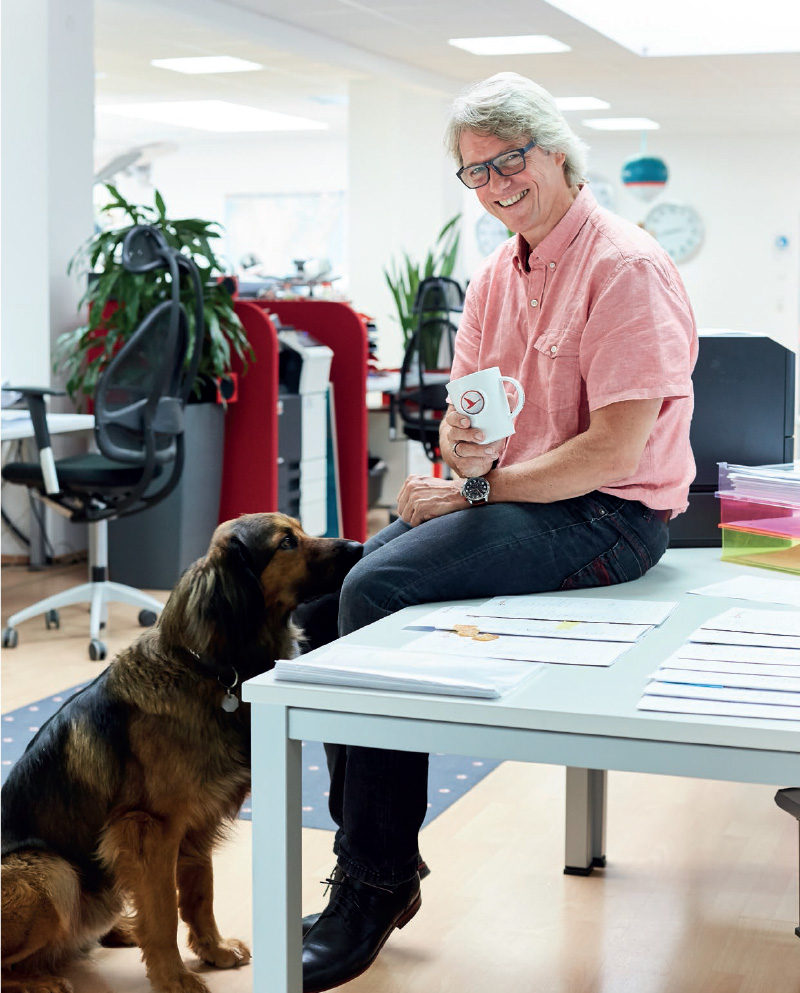
Volker, you have a Scottish father and a mother from Lippe: Honestly – who do you root for in football?
Definitely England!
Why not Scotland?
Oh, I don’t take it that seriously (laughs). My father would emphasize again that I’m half Scottish. I’m more relaxed about it and simply consider myself half British, having grown up here in Germany as the child of soldiers. But seriously: at the next World Cup, I’ll probably be rooting for Germany. The team has developed enormously compared to the English, who unfortunately seem stuck in their kick-and-run style. What the British still have over the Germans, though, is their fighting spirit and very special energy.
You yourself are also very active in sports, but you’ve also had some bad luck with accidents…
That’s right. I used to go to a British school and played a lot of rugby there. Contrary to all the stereotypes, it’s a real gentleman’s sport. Because rugby players know exactly how to hurt you and therefore avoid doing so. It’s a matter of respect. Later, at the German school, rugby wasn’t an option anymore, and I took up other sports like badminton and raceboarding. And I gave it my all. Half measures aren’t for me. While raceboarding, I once shattered the head of my femur. Since then, I’ve had osteoarthritis in my knee and have to avoid impacts and falls. Doctors then recommended cycling to me.
What happened next?
Regular cycling quickly became too boring for me, and after two years, I went mountain biking across the Alps for the first time. That’s probably not what the doctor had in mind when he recommended cycling (laughs). Later, I crossed the Alps several more times, and when I built my house, I deliberately chose a location near the Teutoburg Forest. There are simply tons of beautiful trails for mountain bikers and road cyclists there. Unfortunately, I had my next accident there five years ago. I fell awkwardly and landed headfirst on the ground. Luckily, thanks to my helmet, my head itself was unharmed. However, the impact traveled through my entire spine and shattered a vertebra. I also swallowed my tongue. If I had been riding alone at the time, I would certainly have died. A friend acted as my first responder and saved my life.
How do you cope with such experiences psychologically?
I’m convinced that you have to confront the issue again as soon as possible. As soon as I possibly could, I started cycling again and quickly regained my confidence. I’ve now switched from a mountain bike to a road bike. I also go swimming, which is really good for my back. So, sport is and always will be an important way for me to unwind.
Your professional life hasn’t always been smooth sailing either. Do you have any tips for dealing with challenges as an entrepreneur?
Over the years, I’ve experienced some major personal disappointments. This was partly due to my ex-wife, who caused quite a stir in the company when I left her. Nevertheless, I’m convinced that you can emerge stronger from any crisis – provided you’re willing to actively tackle the challenge. Fundamentally, though, a strong personal support network is crucial. While I built everything myself from the very beginning, I could never have done it without my family and my team. Despite all the disappointments, it’s always been important to me to approach people openly. As a Brit, that comes very easily to me, and I also have a bit of a savior complex. If I can support people, I do it, even if I don’t get anything out of it myself. But I’m convinced that good deeds are rewarded in one way or another eventually.
Did you always want to be an entrepreneur?
I think you either have the entrepreneurial gene or you don’t. And that’s perfectly fine. It would be disastrous if everyone could only find happiness as a business founder. Besides, self-employment is rarely something you can really plan. I didn’t wake up one morning and decide I wanted to start a business. You usually grow into it gradually, but you should start thinking about where you want to go very early on. That’s something I also pass on to my employees. Thinking ahead is incredibly important.
What qualities characterize a good entrepreneur?
A certain willingness to take risks is important. Those who only play it safe won’t get far. But this willingness to take risks must always be accompanied by a strong sense of responsibility. Skyline Express now supports 42 families, and that naturally comes with a lot of responsibility. You have to grow into that, too.
Were you surprised by this success?
Yes, as I said, something like this is hard to plan (laughs).
Do you have any role models?
Role model is such a big word. I think Richard Branson, the founder of Virgin, is fantastic. Steve Jobs and Elon Musk are also inspiring, of course, but not direct role models for me.

Despite the current crises, you’re constantly looking for new employees…
Yes, absolutely! The problem is, air and sea freight specialists don’t exactly grow on trees here in beautiful East Westphalia-Lippe (OWL). And what sets us apart is our holistic approach. We don’t just specialize in one area of logistics; we cover everything. Finding people who think alike isn’t easy. In principle, a person’s character and values are more important to me than their expertise. That’s why we also have very positive experiences with dedicated career changers. In addition, our customers are spread all over the world. So, the first thing I do in the morning is check my phone to see what’s been happening overnight in Asia or America. A motivated employee would do the same – albeit in a less intensive way. We’re essentially looking for “entrepreneurs within the company.” That sums it up perfectly. People who think independently and don’t just clock in and out.
That doesn’t sound like a healthy work-life balance.
(This doesn’t sound like a good work-life balance.) Let me put it another way: I don’t need anyone with a bureaucratic mindset. What’s important to me is that the work gets done. When exactly that happens is secondary. Take working from home, for example: Maybe someone picks up their child from daycare in between tasks and then sits down at the computer for an extra half hour in the evening. Flexibility has always been a major advantage we offer our team. If the projects are running smoothly and the clients are satisfied, you can go home at 3 p.m. for all I care. The result is what counts. We’re also seriously considering introducing a four-day week and testing how feasible that is for us.
Flexible working hours and working from home require trust. Do you extend a kind of trust to your team in this regard?
Absolutely. This also means that certificates and grades no longer play a role in our application process. I’ve seen far too many people rejected in the past who would have been an excellent fit, simply because their grades weren’t outstanding. That’s different now. Today, I personally meet and get to know everyone who applies to us. That’s the only way we can find the right employees.
You also offer apprenticeships. Why is the logistics sector attractive to young professionals despite all the crises and challenges?
Quite simply: Every day is different. Every customer is different, and every order is different. Sometimes you have to solve really complex problems, even for customers who might not have taken you seriously before. I experienced that myself. Especially when I was younger, I met managers from the US who promised all sorts of things but then awarded the contracts to the big players. Later, some of these managers had problems that needed to be solved quickly, and we implemented them. That’s how trust is built, and that’s how you grow. Besides, logistics is a very future-proof industry. Nothing works in the global economy without logistics. As long as teleportation hasn’t been invented, our services will be in demand, and the career prospects are excellent.
What do you actually think about the idea of banning short-haul flights?
Nasty question (laughs). I think the idea is good in principle. I’ve been a Greenpeace member for over 30 years, and of course, it’s completely insane to take a 45-minute flight for a domestic trip. Unfortunately, the alternatives are poor. The trains are too slow, and train travel itself is too expensive. This is where we need to start.
You wouldn’t expect to find a logistics company at Greenpeace…
The reality is that things have to get from A to B. But we do strive to make this as sustainable as possible. Our vehicles are hybrid or electric, and we have solar panels on our roofs. Furthermore, as the first German air freight forwarder, we’re partnering with Air France to promote the development of environmentally friendly aviation fuels. These so-called Sustainable Aviation Fuels (SAF) reduce CO2 emissions by up to 85 percent. They also have no negative impact on biodiversity and don’t contain any raw materials suitable for food production. We’re very proud of this commitment.
You’ve traveled to almost every country in the world. Could you imagine emigrating one day?
First of all, the frequent travel is definitely an advantage of working for us. So, if you want to see a lot of the world, Skyline Express is the perfect place for you. But to be perfectly honest, every time I come back to Germany after a trip halfway around the world and step off the plane, I think, “What wonderfully fresh air!” (laughs). It’s a totally mundane thing, but for those who
Anyone who has seen a lot of the world will understand me. So yes: I love getting to know different cultures and I even fell in love with the British Hong Kong, but I would never want to emigrate. I’m far too happy in Germany for that. My roots are here in East Westphalia-Lippe (OWL).
What do you think is an underrated quality of East Westphalia-Lippe?
I’m half from Lippe and half Scots. Both are known for their frugality. I’m not stingy, but I am quite stubborn, and that’s definitely an underrated quality that distinguishes this region and ensures our success in OWL. We also have beautiful nature here, like the Teutoburg Forest, and an incredibly diverse cultural scene. OWL itself is always worth a visit!
